Types of loudspeakers
Loudspeakers can be classified by their transduction method, radiation method, frequency range, or physical arrangement.
Moving-coil drivers
.jpg)
The moving-coil driver is the most common design. A voice coil moves in a permanent magnetic field and drives a cone or dome.
Advantages:
- Mature and widely available
- Suitable for almost every frequency range
- Compact and relatively economical
- Can provide high excursion
Challenges:
- Usually modest efficiency as a direct radiator
- Suspension and motor nonlinearities
- Diaphragm breakup at higher frequencies
- Directivity narrows as the radiator becomes large relative to wavelength
Compression drivers and horns
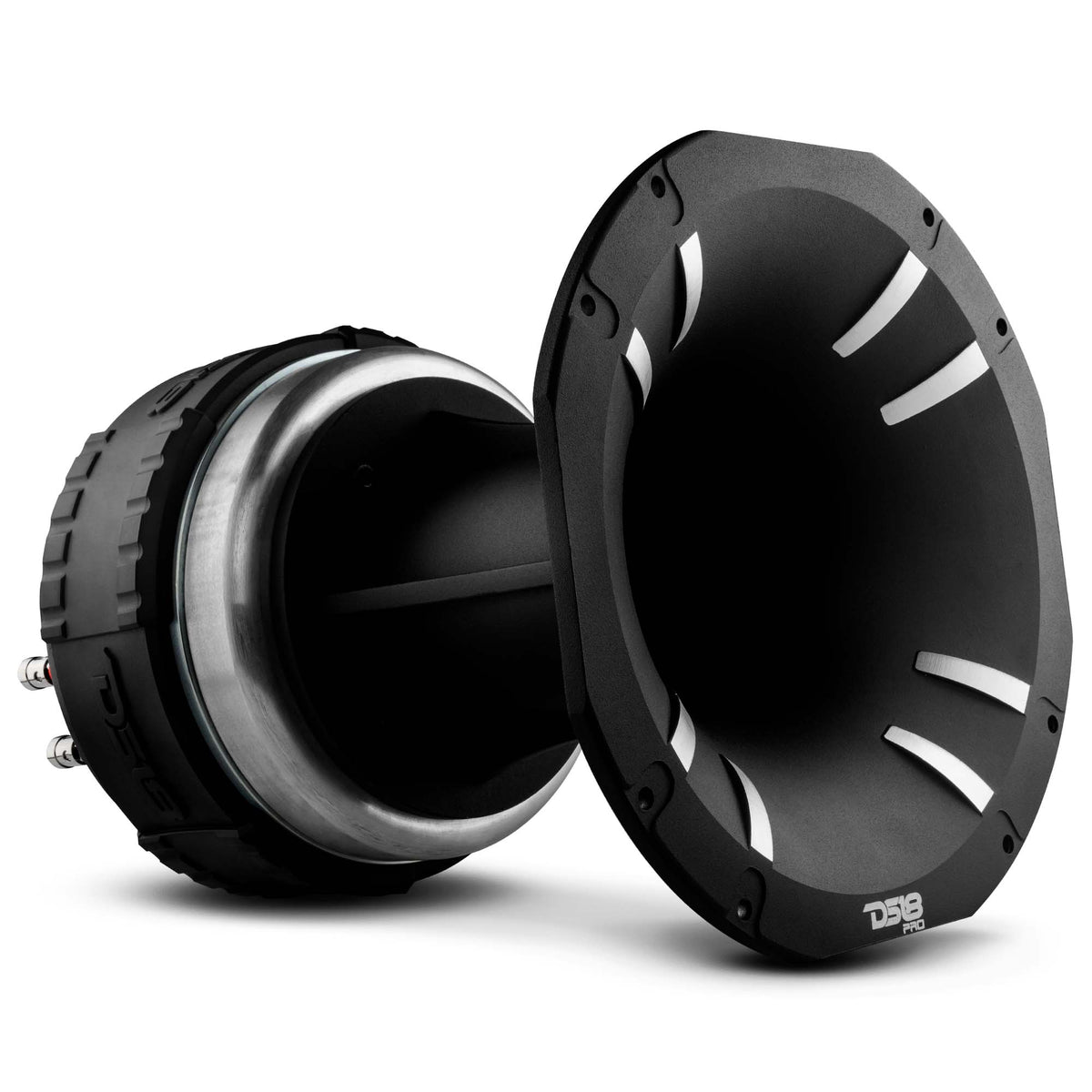
A compression driver feeds a horn through a small throat, often using a phase plug to organize the wavefront.
Advantages:
- High efficiency
- High maximum output
- Controlled directivity
Challenges:
- Horn resonances and diffraction must be controlled
- Directivity must be matched through the crossover region
A horn is an acoustic loading device; it is not a separate electrical transduction principle.
Coaxial and dual-concentric drivers
.webp)
A coaxial system places the high-frequency driver on the acoustic axis of the low-frequency driver.
This can reduce variations caused by driver spacing, although the cone, waveguide, and crossover still require careful design.
Full-range drivers
.png)
A full-range driver attempts to cover most of the audible range without a conventional crossover.
It offers simplicity and a compact acoustic source, but one diaphragm must satisfy conflicting requirements for bass displacement, midrange behavior, and high-frequency dispersion.
Driver roles
- Subwoofer: Lowest frequencies
- Woofer: Bass and lower midrange
- Midrange: Middle frequencies
- Tweeter: High frequencies
- Super-tweeter: Upper treble
- Full-range: Attempts to cover most of the spectrum
No driver type is automatically superior. Implementation matters more than labels.